
WAKE UP, RESIDENTS OF LOVELAND.
With little fanfare, the rules regarding use of your public recreational fields has just changed significantly.
Up until July/2025, the Loveland Field-Use Policy (LFUP), in-effect for the last 10 years, has dictated that any sports organization utilizing Loveland parks be run by all-volunteers and ‘mostly serve’ the residents of Loveland. Since 2017, the Loveland Youth Soccer Association (LYSA), which includes FC Storm (competitive) as part of its organization, has progressively violated the LFUP. Its operational proceeds have mushroomed from ~$180k/yr as an all-volunteer organization to approaching ~$1MM as an organization that now hires salaried professionals and contractors. It also claims to serve at least 24 local communities, while the number of non-Loveland residents being served by LYSA could be as high as 50%. Scroll to the bottom of the archived ’24 local communities’ link for ‘Serving’ advertisement.
This all changed in July/2025 when Parks & Recreational committee members (Sherry Hamlin, John Hart, Doug Hyrne, Chris Redmond, and Dan Timmerman) voted unanimously (with Hyrne recusing) to strike the LFUP provisions in which LYSA was in violation of. Rather than enforce the policy, to the benefit of the entire youth of Loveland, they accommodated the violations. With this vote, Loveland has succumbed to the ‘pay-to-play’ trend in youth sports that has overtaken our culture.
What is most disconcerting about this action is the lack of real attention to the issue. In the 6-8 times that I have appeared before the Parks & Rec committee, lobbying for a small commitment of field-space, there were rarely more attendees than there were board members. There was no public record of deliberation regarding changes to the LFUP; these changes were discussed in a closed (working) session and summarily accepted at the next committee meeting.
For two years straight, 2024 and 2025, RB Loveland has submitted a fully qualified field-use application to the Parks & Recreation committee to offer an ‘All-Volunteer’ competitive soccer experience exclusively to the youth of Loveland. There was never a response from the city as to whether the application was approved or denied…it was just ignored…pushed off long enough to accommodate the current violations.
If you are wondering to yourself why youth sports cost so much, this is why. What has transpired recently isn’t anything that can’t be reversed, but it needs attention and momentum. If you are a parent/coach that would like to form a team of Loveland kids to play competitive soccer, please reach out and let’s make the case together and ‘pull this issue into the light’. RB Loveland is being actively maintained as a 501(c)(3) Non-Profit organization for when additional community-minded individuals are ready to step forward and challenge this policy. You can reach me at scott.wheeler@yahoo.com.
Last word…these arguments haven’t just been at the Parks & Recreation committee level; they have also been made to the Loveland City Council by myself over the last 2-1/2 years. What follows is an email to current Mayor/City Council members…which was never responded to:
MY EMAIL TO LOVELAND CITY COUNCIL:
Subject: Loveland Field-Use Policy violations by LYSA
Greetings,
My name is Scott Wheeler and I am bringing this to your attention as it has fallen upon deaf-ears in the Parks & Recreation council for the last 12 months. In my efforts to start an all-volunteer competitive soccer club serving the youth of Loveland, I was introduced to the Loveland Field-Use Policy (LFUP) as an obstacle (my opinion) to those efforts. I was surprised to discover that LYSA is not just in violation of this policy, but in egregious violation for the last several years.
Under the banner of ‘Non-Profit’, and having zero oversight, the FC Storm arm of LYSA has been allowed to evolve into a regional commercial competitive soccer club. This has put competitive soccer behind a pay-wall for more than half of Loveland youth and effectively closes their pathway to the high-school game.
The LFUP states that all Youth Sports organizations that utilize Loveland fields be run with ‘all-volunteer’ resources. LYSA’s most recent IRS Form 990 filing (2023) has it collecting/spending over $700,000. Over $90,000 of this is overtly claimed as Executive compensation, which puts them in clear violation of the LFUP. Given my first-hand experience with LYSA, this is but the tip-of-the-iceberg with respect to paid-labor within the organization. There is a much larger amount paid to administrators, coaches, trainers, and consultants that is obscured in various line-items on their Form 990. One might start by questioning the $143,000 that LYSA claims to have paid in ‘Field Cost and Maintenance’ while remitting only $10,000 annually to the City-of-Loveland. My recommendation to the Parks & Rec council back in September of last year was that they perform an audit on LYSA’s bank statements to determine the degree of non-compliance.
The leadership of LYSA are so unworried about compliance with the LFUP that they now openly advertise ‘jobs’ on their website. As I type these words, you can find two Coaching-related positions advertising for ‘$25,000-35,000 annually’. Links to these postings can be found below. You’ll need to drill-down via the ‘Read More’ button for the salary mentions.
LYSA holds itself out as transparent and community-driven, but it is anything but. In September of last year, I brought LYSA’s highly-unconventional governance as a non-profit to the attention of the Parks & Rec council. No action, that I am aware of, has been taken. Unlike the Loveland Youth Football and Baseball organizations, LYSA does not have open-elections for its board members. Unbelievably, to be a board member of LYSA, you can only be elected by current board members. Furthermore, to be the President of LYSA, you must have served on the board of directors and can only be elected by the board-of-directors. Further obstructing any accountability by the community is the requirement that all board members sign a Non-Disclosure Agreement (NDA) indicating that they won’t discuss any club business with outsiders. This isn’t hearsay; this is documented in their organizational Bylaws…which are near impossible to find anywhere publicly. This organizational design isn’t meant to invite accountability (like Football & Baseball), but purposely designed to avoid it.
The first policy position of the LFUP is “to first serve the Loveland residents participating in the general recreational level of play.” As FC Storm has evolved into a regional competitive club, serving/growing the recreational arm of the organization has become a disincentive and accordingly…a conflict-of-interest. I have volunteer-coached for LYSA for 5 years and one season for FC Storm. 30% of my FC Storm team was from outside the Loveland City School District (LCSD). In my conversations with other former coaches in FC Storm, they have indicated that as much as 50% of FC Storm participants could be from outside the LCSD. Rather than develop the youth of its own community to play competitive soccer, LYSA has opted to focus its attention on participants that can afford to ‘Pay-to-Play’. The result of this decision has been to effectively cut-off more than half the youth of Loveland from a pathway to play competitive soccer for their own high school. It simply becomes unaffordable beyond the recreational level of play. Paying/Playing for FC Storm today isn’t really any different than playing for other area competitive organizations such as Kings Hammer, Cincinnati Elite, Cincinnati United, or even Impact. Again, as I write, you can find 3 players from outside the LCSD celebrated on the FC Storm homepage for making their high school teams. There are no LCSD players featured for making Loveland High School teams.
As it stands right now, Loveland is yet another community that has let itself fall into the soccer ‘Pay-to-Play’ trap. The ‘pay-wall’ that I refer to is very real. The TOTAL annual cost of playing competitive soccer for FC Storm (~$2,200) is roughly 10x the cost of playing recreational soccer (~$200). Not much thought is given to it, but this jump from recreational to competitive soccer represents about 4% of median household take-home pay for our community. This is impossible for half of our community in a good economic climate, more impossible given the one we are in today. FC Storm (LYSA) cannot sustain its current cost structure unless it recruits from more affluent families outside of the LCSD. The LYSA Form 990 receipts that I indicated above were for 2023. Given their trajectory of cost, I would wager that their collections last year topped $750,000. I can’t say for sure as the President of LYSA told me flatly about this time last year that he wasn’t discussing cost with me. Soccer is a game played with a ball on a patch of grass…barefoot in many countries; it shouldn’t cost $1000’s of dollars to play recreationally or competitively.
It’s an uncomfortable topic, but soccer in Loveland needs a correction. LYSA was entrusted with exclusive use of Loveland field-space in accordance with the well-designed LFUP and has responded by trampling that policy. We are, arguably, in the middle of childhood mental-health and obesity epidemics in our country. To put higher-level youth sports development beyond the reach of half our community is unthinkable. It’s time to stop subsidizing surrounding communities, whose priorities are different from our own, and get back to the business of championing our local youth.
I would be happy to appear before you, or even should-to-shoulder with a LYSA representative to answer any questions that you may have.
If you have an interest in forming a team for Spring ’25 or the following 2025-2026 season, please reach out and let’s discuss. Can be for any age group, boys or girls.
If interested, it is IMPORTANT that you contact me well-before February as that is the deadline for submitting field requests to the City of Loveland.
Please contact Scott Wheeler @ the number found at the top of this page or through the Registration contact form.
A QUICK NOTE REGARDING ELIGIBILITY:
- RESIDENCY – Your player needs to reside within the Loveland City School District (LCSD) to be eligible to play for RB Loveland. This requirement ensures compliance with the City of Loveland field-use policy of primarily serving residents of Loveland. While LCSD extends outside of the city limit, we believe this requirement reasonably includes the broader Loveland community while honoring the field-use policy.
Register Here:
RB Loveland is founded with a dual-purpose mission:
Organizationally – To create a performance-based organization that drives cost from competitive soccer and provides greater access to higher-level instruction.
Developmentally – To teach your daughters/sons to play a smart, skilled, and assertive game of soccer and have a great time doing it.
To accomplish this, RB Loveland operates upon the following tenets:
All Volunteer Coaching – Consistent with European grassroots organizations, training will be volunteered by parents invested in their child’s development or by other community members intrinsically motivated to teach the game. There will never be any paid positions within the club, full-time, part-time, contract, or otherwise.
Organizational Design – Consistent with best-practices of European grassroots organizations, RB Loveland will evolve and operate in a democratic manner that promotes team self-governance and organizational autonomy.
Commitment to Real Player Development – Player development is more than simply promoting a more skillful or athletic player to a higher-level team. Long Term Player Development (LTDP) starts with a real plan for comprehensive development to ensure players don’t reach middle U-levels without such fundamental skills as passing effectively with both feet and receiving a ball out of the air. RB Loveland is also committed to providing equal playing time for all players… the ultimate development tool that allows players to apply what they have learned in training. It is our belief that arranging equally matched games is critical to maximizing player development and every effort will be made to ensure that this happens.
Empowerment of Coaches – The coach is the shepherd of her/his team and decides who is added or removed from the roster. Whenever possible, new coaches will be offered guidance with full-season training plans and suggested resources so that they can be immediately productive. Coaches are not required to have a license, but are highly encouraged to pursue one.
Team Formation – RB Loveland will field multiple teams in each age group and movement between teams is strictly voluntary. Coaches must ‘sell’ their ‘product’ to all potential players, internal and external. Most importantly, this approach allows for continuity in team development. As coaches develop their style/system of play with their team, forced player-movements under the guise of ‘player development’ are disruptive to instructing team-based tactics moving into upper U-levels. This approach maintains continuity and keeps everyone focused in the forward direction.
Empowerment of Parents – Though they pay no training fees, parents are recognized as ‘The Customer’ of the Volunteer Coach. If at any point in the season the parents disagree with the style or behavior of the coach, she/he can be removed with 2/3rds approval by the team. Coaches are elected to their positions and re-elected at the end of each season by simple majority. Parents with soccer experience are encouraged to assist in training the team and parents are encouraged to actively observe/enjoy training sessions.
Clarity regarding Performance-based design vs. winning at-all-cost
At first, it might be easy to confuse these two concepts, but they couldn’t be more different. The first concept ensures that coaches and parents, and not just players, are held accountable for delivering their best effort for the team. The second concept is a destructive counter-behavior that works in opposition to the first. It is our belief that commitment to the stated tenets (performance-based) will result in success on the field and the best possible experience for all players.

Scott Wheeler has been a resident of Loveland since 2009. He and his wife have two daughters, ages 17 and 20, that have played soccer since U9, ultimately playing on high-school teams. Their elder daughter is in college studying to be a doctor and the younger aspires to be a Physicians Assistant. While he is proud of their soccer achievements, he is most proud of their academic accomplishments and personal character. It’s his belief that academic performance must take priority over sports participation and he promises to reinforce this with your child.
Scott holds a U.S. Soccer ‘E’ License since 2017 as well as a U.S. Soccer Referee License. He has held Assistant and Head Coaching positions with area competitive clubs and has served a volunteer coach with LYSA since 2016. Parents of his players would likely use adjectives like “fun, competitive, demanding, firm, and fair” to describe his coaching style. During the season canceled by the 2020 pandemic, he self-published his Fall U11 training plan on Amazon, which has been highly rated and reviewed. The content of this work provides useful insight into his comprehensive approach to training and development.
Why So Cheap?!
As a species, humans have an uncanny desire to ‘improve’ things and, as a general-consequence, make them more expensive. Soccer is no exception to this phenomenon…but it doesn’t have to be.
This has happened in our own community. Most recreational players that (might) aspire to play on their high-school team have no financially viable path to do so. The word ‘might’ is in parenthesis as most 8-9 year olds and their parents have no idea that they are walking into the ‘pay-to-play’ trap. If a young recreational player decides he/she wants to try competitive soccer, the total cost-to-play jumps by a factor of 8x-10x. To play club soccer locally, you can expect your total cost to participate to range between $1,500 to $2200 per year. These costs approach 4% of median net-income for households in our area…prohibitive for half of the youth in Loveland.
Here is how RB Loveland drives down costs for a game played on a patch of grass, with a simple ball, and in some countries, without shoes (Heaven forbid):
NO PAID POSITIONS – Other area clubs, even 501(c)(3)s, have multiple full-time paid positions, paid part-time positions, employ high-dollar contractors for training services, and pay coaches to varying degrees. This is largest contributing factor to the bloated cost of delivering competitive soccer today. RB Loveland is committed to all-volunteer coaching/training; completely eliminating the single largest cost to play the beautiful game. This operational approach also allows for growth opportunities for parents that seek to be more involved in their child’s development.
NO OVERNIGHT TRAVEL – The conventional competitive club travels to tournament destinations that require overnight stay. This has become one of the biggest scams in youth soccer and is referred to as ‘stay-to-play’. The way it works is, the hosting club ‘partners’ with local hotels and requires you to stay in a partner hotel at a designated room-rate. It doesn’t matter if you can get a cheaper rate at the hotel next door. Host clubs then receive some type of renumeration in return. Overnight expenses can be one of the greatest hidden costs for a family. RB Loveland is committed to playing in local tournaments and eliminating this cost entirely. The Cincinnati area is rich in competitive tournament opportunities that don’t necessitate overnight travel.
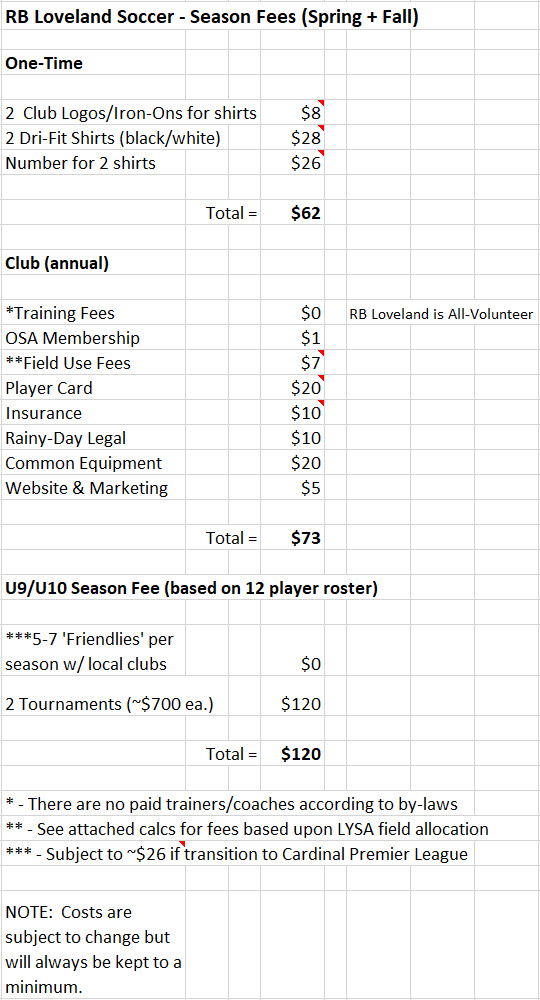
AFFORDABLE UNIFORMS – Rather than engage in ‘partnerships’ with makers of branded uniforms, RB Loveland takes the more reasonable approach of sourcing a high-performance shirt and affixing numbers and logos ourselves…drastically reducing costs. Instead of paying $400-$500 for uniforms, the cost can be reduced to around $62; You buy your own black shorts and socks that you prefer.
INAUGURAL SEASON GAMES – RB Loveland is presently seeking acceptance into the Cardinal Premier League for regular season games starting in the Fall. If the timing doesn’t work out for this season, non-league games will be sourced. There are enough grassroots community-based clubs in our area now to support 5-7 ‘friendly’ games at no cost as coaches and assistants can serve as referees.
Every decision made within RB Loveland will be made with the first objective being to keep costs at an absolute minimum.
Memberships
